For organizations
Human capacity at work.
Working conversations with leaders about decision load, manager strain, change, recovery, and trust.
Explore organizational work → Lighthouse Wellness
A human-capacity application of Lighthouse Leadership Consultants™
For CEOs, people leaders + operations leaders
Your team is hitting the numbers. Managers are absorbing more, decisions keep reopening, and each new change adds to an already full week.
Your people’s expertise creates value when they have the capacity to use it. Lighthouse Wellness helps leaders examine decision load, manager strain, change, recovery, and trust, then choose what the organization can change.
Looking for personal or athlete support? Explore the three paths →
Start with the situation in your organization. Michael leads the human-capacity work; Kristi coordinates the engagement.
Work with Michael
For organizations
Working conversations with leaders about decision load, manager strain, change, recovery, and trust.
Explore organizational work →For adults & families
Learn about Michael’s counseling background and current care access for adults and families.
Explore personal support →For athletes & parents
Support for middle-school and high-school athletes navigating pressure, confidence, injury adjustment, and setbacks.
Explore AnchorAthlete →Where this becomes a leadership question
For executive sponsors who can change priorities, decision rights, workload, handoffs, or the pace of change.
CEOs + operations leaders
The result gets delivered. The same leaders keep rescuing the handoff, reopening the decision, or working around an unclear owner.
What keeps returning to them, and what could the organization change?
People leaders + manager sponsors
They translate changing priorities, manage conflict, cover missing capacity, and answer for work they do not fully control.
Where is manager capacity going, and which expectations need to change?
Executive teams leading change
A new system, an AI rollout, a restructure, or another urgent project lands on top of the current work.
What must stop, slow down, or become clearer for this change to work?
Start with the pressure you can see. The working session examines the conditions behind it.
What Michael helps leaders examine
Look at the way work happens: decisions, expectations, staffing, handoffs, and the signals people can safely raise.
How much judgment is required, who owns the call, and how often a settled decision reopens.
The workload, interpretation, conflict, and escalation managers absorb around their formal role.
How many changes people must absorb at once and what support or time each one needs.
Whether workload rhythms, staffing, handoffs, and expectations leave room to recover.
Whether people can surface risk, limits, disagreement, and uncertainty early enough to be useful.
Where current results depend on hidden labor, repeated rescues, or people continually extending themselves.
A first organizational engagement
Bring the people close to the work and the leader who can act on what surfaces. Michael facilitates the conversation around a real operating pressure.
What are people being asked to deliver or absorb? Who is carrying the pressure?
Where are decision load, manager strain, change, recovery, or trust making the work harder?
What can leadership adjust: a priority, owner, expectation, role, handoff, cadence, or support?
Who owns the next step, and what observable signal would show that the change helped?
The aim is a clear view of the pressure, priorities leadership can act on, and a practical next step with an owner and evidence to watch. The people, timing, and scope are agreed before the work begins.
The experience behind the work
Principal + Chief Wellness Officer, Lighthouse Wellness
Michael’s behavioral-health experience spans outpatient care, crisis work, community mental health, substance use, and managed care.
He brings that depth to organizational questions: what people are carrying, how pressure changes behavior, and which conditions leadership can actually change.
Lighthouse Wellness works with leaders on decisions, manager capacity, recovery, trust, and sustained performance. Michael leads the human-systems work; Kristi connects it to the enterprise goal and engagement scope.
Start a human-capacity conversationFor personal support, explore Michael’s adult and family counseling page. Availability and service location are confirmed through the practice.
Adults & familiesAnchorAthlete™Clinical credentials · Psychology Today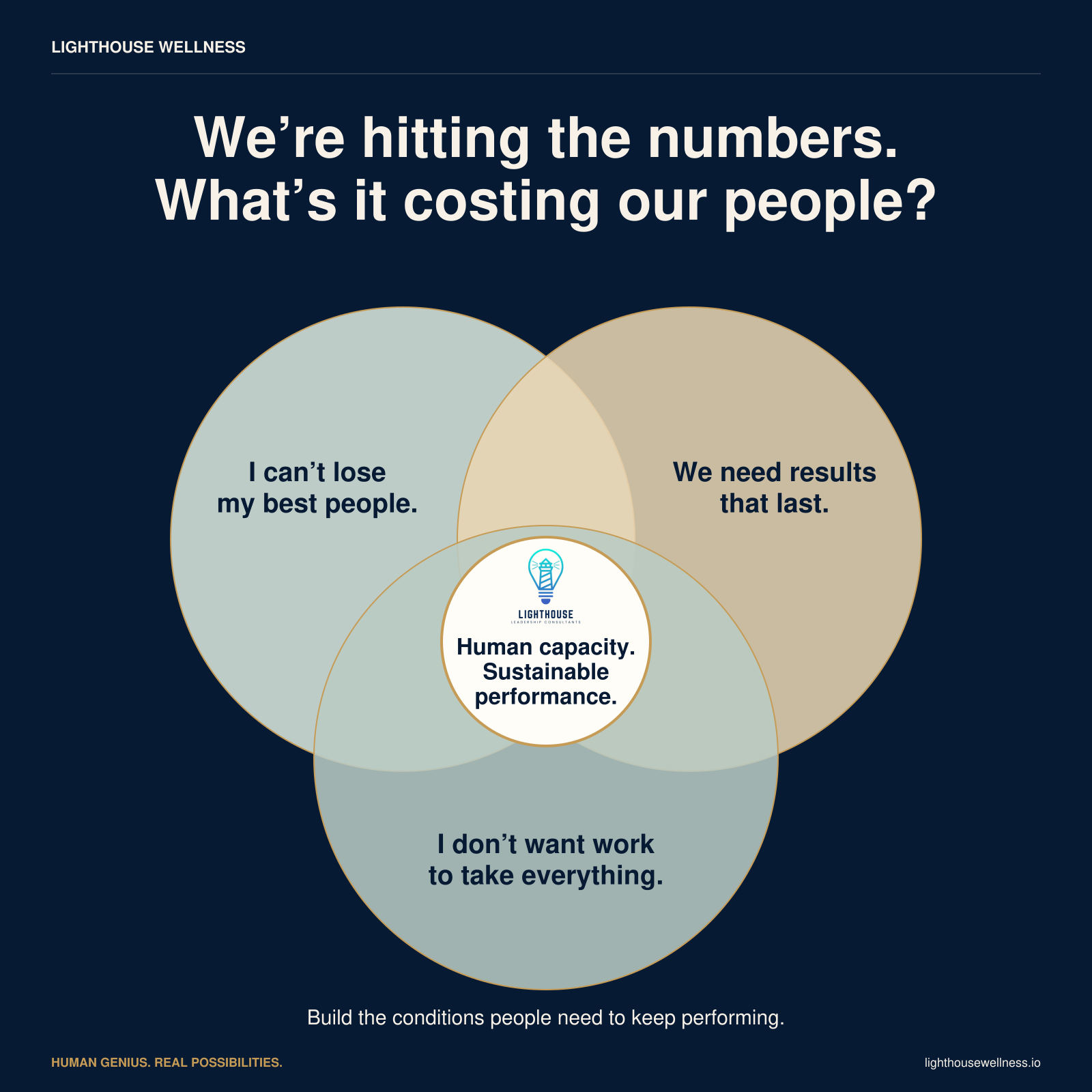
Private organizational working rooms
A focused working conversation brings leaders together around a real question about capacity, decision load, or manager strain. Michael leads the human-capacity work. Lighthouse’s Rare Rooms™ approach shapes the curation, conversation, and follow-through.
The October 14 invitation is closed. Future organizational sessions are scoped and scheduled by agreement.
Discuss a working room for your organization ↗Before you inquire
A CEO, COO, CHRO, Chief People Officer, business-unit leader, or executive sponsor with authority to change the conditions being discussed. People, HR, Operations, and Chief of Staff leaders can help surface the real patterns.
Start with what you can see: decisions reopening, managers covering gaps, competing changes, or work that depends on repeated rescues. The first conversation helps determine the useful focus.
This work examines organizational conditions with leaders. For personal counseling, visit the adults and families page. Clinical services have their own intake, records, and care arrangements.
You can inquire directly about your organization. The October 14 room is a separate, curated working conversation for a small group of practitioners.
Start with your organization
Tell us what is happening. We’ll help identify the useful next conversation.
This opens an email to Kristi with prompts you can fill in. Kristi reviews enterprise inquiries and coordinates the fit and scope with Michael.
Lighthouse Wellness is the human-capacity application of Lighthouse Leadership Consultants™.